Every morning at 7:15 AM, Aman Jha boards the passenger train from Ujjain Junction to Indore. Aman is a senior QA automation engineer who lives in the peaceful temple city of Ujjain with his family and commutes daily to an American multinational IT firm located near Indore’s Super Corridor.
Aman had spent 4 years and 9 months at his current company—writing test suites, squashing critical release bugs, and watching the firm grow. When a Pune-based fintech offered him a 40% salary hike, he decided it was time to resign.
Over lunch on his last working week, Aman was chatting with an HR executive about his full-and-final (F&F) settlement.
"Aman, you haven't completed a full five years here," the executive told him casually. "You're short by three months. So unfortunately, you won't be eligible for gratuity. That ₹2.8 Lakhs provision in your CTC breakup simply lapses back to the company."
Aman felt a gut punch. Was nearly five years of loyal service, late-night sprint deployments, and a grueling daily inter-city commute completely discarded over a 90-day technicality?
He called me that evening from the train platform. We pulled up the Payment of Gratuity Act, 1972, judicial precedents, and the statutory formula.
The reality? The HR representative was wrong. Under statutory continuous service rules, Aman was 100% entitled to his full gratuity payout of ₹2,88,462—completely tax-free.
If you are a salaried employee in India, gratuity is not a discretionary bonus or a corporate favor; it is a statutory right. Let’s break down the rules, the 15/26 formula, the five-year myth, and how the evolving labor codes impact your hard-earned money.
What is Gratuity? The Foundation of Employee Appreciation
Gratuity is a lump-sum statutory benefit paid by an employer to an employee as a token of gratitude for rendering continuous, long-term service.
* Why is it important? Unlike monthly salaries that get consumed by rent and EMIs, gratuity serves as a dedicated, tax-sheltered lump-sum cushion that builds your long-term wealth, funds mid-career transitions, or strengthens your retirement corpus. * Governing Legislation: In India, gratuity is governed by the Payment of Gratuity Act, 1972. It applies to every factory, mine, port, railway, shop, or private establishment employing 10 or more people on any day of the preceding 12 months. Once the Act applies to an organization, it remains applicable even if the headcount later drops below 10.
Eligibility Criteria: Does the 5-Year Rule Still Apply?
Under the standard provisions of the Act, an employee becomes eligible for gratuity upon separation (resignation, retirement, superannuation, or retrenchment) after rendering continuous service of not less than 5 years with the same employer.
The 5-Year Myth vs. The 240-Day Rule (Aman's Breakthrough)
Most HR departments strictly enforce 5 calendar years (1,825 days). However, Section 2A of the Payment of Gratuity Act defines "continuous service":
* If an employee works in an establishment with a 6-day work week and completes 240 working days in the 5th year, it is legally counted as a full year of continuous service. * If the establishment follows a 5-day work week (standard across IT and corporate MNCs), completing 190 working days in the 5th year qualifies as continuous service! * Various High Courts (including the Madras and Karnataka High Courts) have repeatedly upheld that an employee who completes 4 years and 240 days (or roughly 4 years and 6 to 8 months) without unapproved leave cannot be denied gratuity!
Exceptions Where the 5-Year Rule Is Waived: The 5-year continuous service requirement does not apply if an employee's service ends due to:
* Death of the employee (payable directly to the legal nominee). * Total permanent disablement caused by an accident or disease.
How is Gratuity Calculated? (The Universal 15/26 Formula)
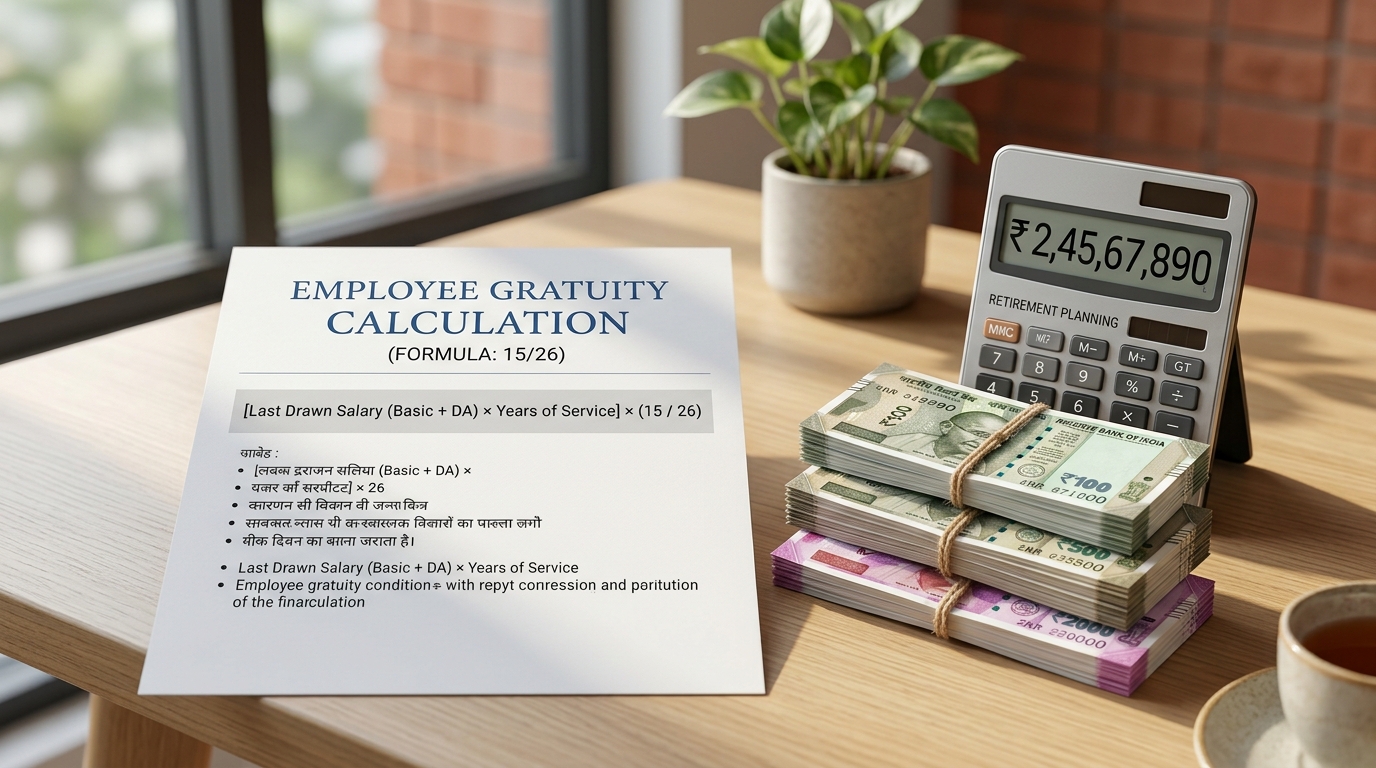
For employees in establishments covered under the Payment of Gratuity Act, the calculation follows a standardized statutory formula:
```text Gratuity = (15 × Last Drawn Basic Salary + DA × Tenure in Years) / 26 ```
Breaking Down the Variables:
1. 15 Days of Salary: Represents half a month's earnings (15 days). 2. 26 Working Days: The law considers a working month to have 26 days (excluding 4 statutory Sundays). Dividing by 26 yields your real daily wage, which is higher than dividing by 30! 3. Last Drawn Salary: Strictly includes Basic Salary + Dearness Allowance (DA). It excludes HRA, special allowances, variable incentives, and bonuses. 4. Rounding Up Tenure: If you serve more than 6 months in your final year (e.g., 4 years and 9 months), it is rounded up to the nearest whole integer (5 years). If you serve 4 years and 4 months, it is rounded down to 4 years.
Real-Life Calculation: Aman Jha's Settlement
* Last Drawn Monthly Basic Salary: ₹50,000 * Dearness Allowance (DA): ₹0 (Private MNC) * Tenure: 5 Years (4 years & 9 months rounded up)
$$\text{Gratuity} = \frac{15 \times 50,000 \times 5}{26} = \mathbf{₹2,88,462}$$
Crunch Your Own Numbers: Open Our Free Gratuity Calculator to plug in your last basic pay and get your exact statutory payout in seconds!
What Changes Under the Code on Social Security?
The government consolidated 29 central labor laws into four unified codes, including the Code on Social Security. When fully enacted across all Indian states and Union Territories, it introduces structural updates:
1. The Revised Definition of "Wages" (The 50% Rule): Under the old structure, corporate payrolls kept Basic Pay low (around 30% to 40% of CTC) and loaded the rest into special allowances to minimize gratuity and PF outgo. The New Mandate: "Wages" must comprise at least 50% of the employee’s total gross remuneration. If allowances exceed 50%, the surplus is automatically added back to wages, expanding the base for gratuity calculations. 2. Fixed-Term Employees (FTE): Contractual and fixed-term workers hired for a specific contractual period are eligible for pro-rata gratuity if they complete one year of continuous service (instead of the 5-year requirement). 3. Career Wage Growth: When statutory wage definitions update, earlier years are calculated on the last drawn salary at the time of eventual exit—ensuring past years benefit from career salary growth rather than being pegged to past wages.
Gratuity in Private vs. Public Sector
| Parameter | Central/State Govt Employees | Private Sector (Covered by Act) | Private Sector (Not Covered by Act) | | :--- | :--- | :--- | :--- | | Applicable Formula | Statutory Pension Rules | (15 * Last Basic * Years) / 26 | (15 * Last Basic * Years) / 30 | | Tax Exemption Limit | 100% Tax-Free (No ceiling) | Tax-Free up to ₹20,00,000 | Tax-Free up to ₹20,00,000 | | Tenure Rounding | As per civil service rules | > 6 months rounded up to 1 yr | Completed whole years only |
Taxation of Gratuity in India: Claiming the ₹20 Lakh Tax-Free Shield
Under Section 10(10) of the Income Tax Act, gratuity received by private-sector employees covered by the Act is exempt from income tax up to the lowest of the following three amounts:
1. The actual gratuity amount received. 2. The statutory formula amount (`15 * Basic * Tenure / 26`). 3. The lifetime statutory tax-free ceiling of ₹20,00,000 (₹20 Lakhs).
Is the ₹20 Lakh ceiling a new amendment? No. The central government increased the lifetime tax exemption limit from ₹10 Lakhs to ₹20 Lakhs in 2018–19. Any gratuity received exceeding ₹20 Lakhs across your entire working lifetime is added to your taxable income and taxed at your marginal slab rate under both the Old and New Tax Regimes.
When Must the Employer Pay, and What Happens on Default?
* 30-Day Statutory Deadline: Under Section 7(3), your employer must calculate and disburse the gratuity amount within 30 days of it becoming payable (from your last working day). * Penalty for Delay: If an employer delays payment beyond 30 days without a valid dispute, Section 7(3A) mandates that the employer must pay simple interest (typically 10% per annum) from the due date until actual payment. * Remedy: If an employer refuses or fails to pay, you can file a formal complaint with the Controlling Authority under the Payment of Gratuity Act (District Labor Commissioner).
Checklists for Employees and Employers
What Employees Should Check Before Signing the F&F Settlement: * Verify the Last Drawn Basic Pay: Ensure your F&F uses your final, revised basic salary, not your starting or average pay. * Check Tenure Rounding: If you served 4 years and 9 months, verify that the calculation uses 5 years, not 4. * Check the 240-Day Threshold: If you are resigning near the 4.7-year mark, do not surrender your gratuity without checking continuous service records. * Form I Submission: Submit Form I (application for gratuity payment) to your HR team along with your resignation clearance.
What Employers and Payroll Teams Must Update: * Ensure wage structures keep core wages near 50% of CTC to avoid retroactive liability spikes. * Maintain clean biometric and muster-roll records of active working days in the final year. * Set aside an actuarially sound Gratuity Trust Fund (via LIC or corporate trust) so bulk employee exits never strain operational cash flow.
How Gratuity Fits Into Your Broader Retirement Planning
Gratuity is not windfall cash to spend on shopping sprees or luxury vacations. It is a debt-free, lump-sum wealth injection.
When Aman received his ₹2.88 Lakhs gratuity settlement, he didn't leave it idling in a 3% savings account. He allocated it systematically:
* ₹1 Lakh went to top up his Emergency Fund. * The remaining ₹1.88 Lakhs was invested into equity mutual funds through a disciplined plan on our SIP Calculator.
Plan your full financial roadmap using our suite of interactive tools:
* Calculate Your Exact Gratuity Settlement on Our Gratuity Calculator * Check Your In-Hand Take-Home on Our Salary Calculator * Simulate Tax Liabilities on Our Income Tax Calculator * Plan Long-Term Wealth on Our Retirement Calculator * Explore All 26 Free Tools on Our Financial Suite
Aman stood his ground, submitted the relevant sections of the Act to his company’s HR leadership, and received his full statutory gratuity with his final paycheck.
Know your statutory rights, run the math yourself, and never leave your hard-earned corporate dues on the table!