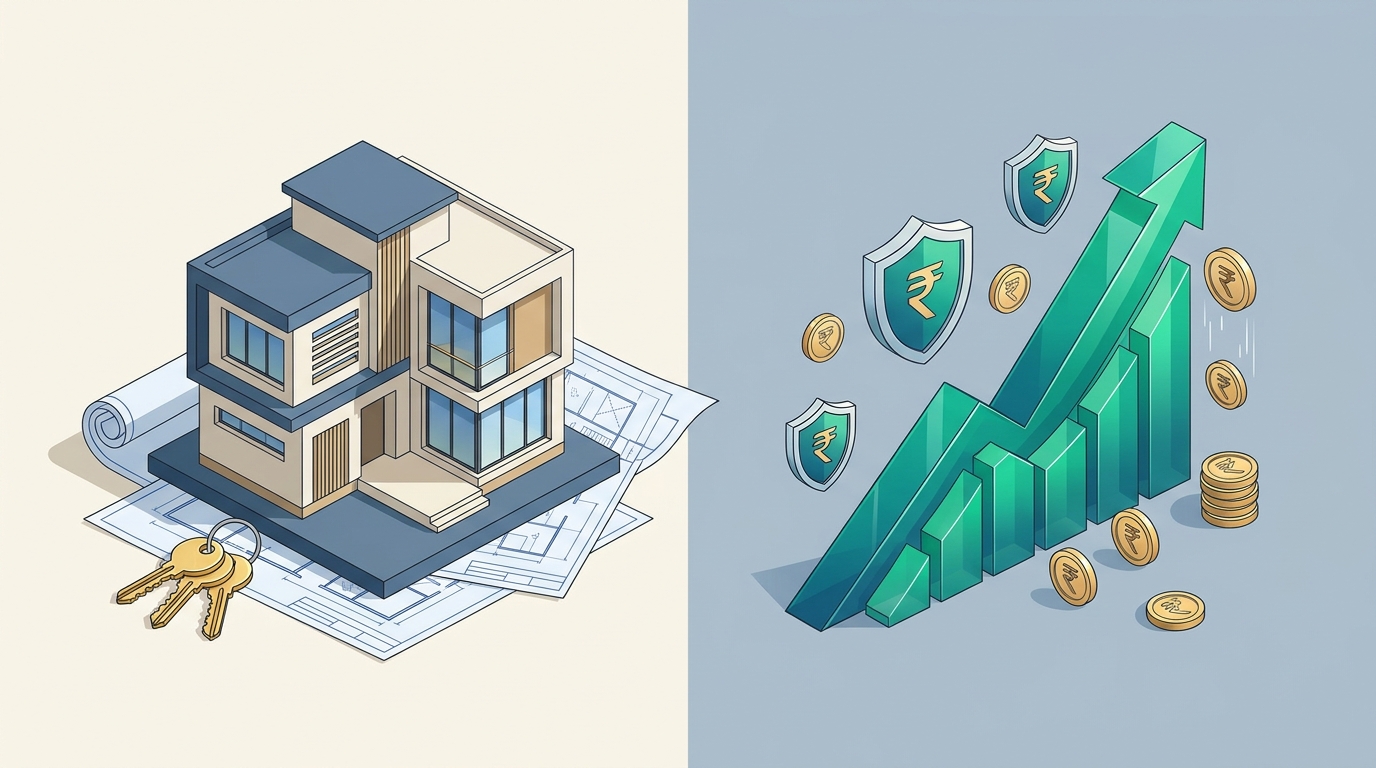
I recently sat down with Lokesh Sahu, a hardworking professional based in Indore. Lokesh is currently at a career stage where he has about ₹20 Lakhs in savings. Like many in Indore, Bhopal, Jaipur, or Lucknow, he is caught in the classic Tier-2 city dilemma: “Should I use this money as a down payment for a ₹1 Crore luxury apartment, or should I keep living on rent and let my money grow in the equity markets?”
Lokesh isn't just worried about the price tag. He is worried about the opportunity cost. He asked me a question that haunts every middle-class Indian: "Is a house truly an asset if it takes away my ability to invest in the market for the next 20 years?"
It’s time we stripped away the emotional bias and looked at the cold, hard math of Real Estate vs. Equity SIPs.
The Scenario: Buying a Home vs. Investing in SIPs
Let’s look at the numbers Lokesh was weighing. He could either buy a ₹1 Crore home in a premium locality in Indore or continue renting and invest that same down payment and monthly EMI surplus into a well-diversified SIP.
#### Sibling A: The Homebuyer (Lokesh)
* Down Payment: ₹25 Lakhs (Savings + Registration). * Loan: ₹75 Lakhs at 8.75% for 20 years. * Monthly EMI: ~₹65,000. * Additional Costs: Property tax, society maintenance (₹5,000/mo), and interior repairs.
#### Sibling B: The Disciplined Investor
* Investment: ₹25 Lakhs lumpsum in a Nifty 50 Index Fund. * Monthly SIP: ₹65,000 (The amount Lokesh would have paid as EMI). * Expected Return: 12% CAGR.
Real Estate vs. Equity SIP: The 20-Year Accounting
After 20 years, here is how the balance sheets look:
| Parameter | Sibling A: ₹1 Cr House (Indore) | Sibling B: Nifty 50 Lumpsum + SIP | | :--- | :--- | :--- | | Initial Capital Deployed | ₹25 Lakhs (Down Payment + Registration) | ₹25 Lakhs Lumpsum | | Monthly Outflow (20 Years) | ~₹65,000 EMI (+ ₹5,000 Maintenance) | ₹65,000 Monthly SIP | | Assumed Annual Growth | 6% Property Appreciation | 12% Equity CAGR | | Total Bank Interest Paid | ~₹80 Lakhs | ₹0 | | Estimated Value After 20 Years | ~₹3.20 Crores | ~₹6.50 Crores |
#### 1. The Real Estate Journey
In a Tier-2 city like Indore, real estate appreciation has been strong. If Lokesh’s house appreciates at 6% per year (a generous average for many Tier-2 suburbs), his ₹1 Crore home will be worth roughly ₹3.20 Crores in 20 years.
* The Hidden Reality: Lokesh will have paid roughly ₹80 Lakhs in interest to the bank. When you subtract the total cost (Down payment + EMI + Interest + Maintenance), his "net wealth gain" from the house is significantly lower than the headline price of ₹3.20 Crores.
#### 2. The SIP Journey
If Sibling B invests ₹25 Lakhs and SIPs ₹65,000 every month at a 12% return:
* Corpus after 20 years: A staggering ₹6.5 Crores. * The Headline Gap: Even with a conservative estimate, the equity route builds nearly twice the net worth of the physical house.
Understanding the Real Estate vs. Equity Difference
#### The Advantages of Real Estate
* Forced Savings: An EMI is a debt that must be paid. It builds an asset even if you aren't disciplined. * Inflation Hedge: Construction costs (steel, cement) rise with inflation, keeping property values rising over long cycles. * Emotional Utility: You cannot put a price on the freedom to paint your walls, grow a garden, or give your child a permanent address.
#### The Advantages of SIP and Equity
* Liquidity: If you need ₹5 Lakhs for a medical emergency, you can sell a portion of your mutual funds in 24 hours. Selling a flat can take months. * Diversification: With ₹5,000, you can own a tiny piece of India’s top 50 companies. With ₹5,000, you cannot even buy a square inch of a good property. * Compounding: Equity markets allow your gains to be reinvested and compounded daily.
Why Tier-2 Cities Like Indore are a Different Beast
When you buy in Indore, Bhopal, or Jaipur, you aren't just buying space; you are betting on the "Development Corridor."
* The Infrastructure Premium: Cities like Indore are seeing massive growth due to better connectivity (like the Metro projects and IT hubs). Properties near these corridors often see "Alpha" growth that beats national averages. * The "Sandwich" Trap: In Tier-2 cities, the rental yield is often lower (2–3%) compared to the cost of borrowing (8.75%+). This "negative carry" means you are paying significantly more to the bank than you would pay a landlord. * The Healthcare & Legacy Corpus: Unlike a stock portfolio, a house cannot help you during your mother's medical emergency. An equity portfolio can be partially liquidated.
Tax Benefits: The Illusion of "Tax Saving"
Many buyers cite Section 24(b) and Section 80C as the primary reason to buy.
* The Reality: Under the New Tax Regime, these deductions are disallowed. Even under the Old Tax Regime, you only save tax on the interest portion, not the principal. * The Math: If your interest payment is ₹4 Lakhs, you only get a deduction of ₹2 Lakhs. You are effectively paying lakhs of interest to "save" a few thousand in taxes. Never buy a house just to save tax. Buy it because you need a home.
The Blended Strategy Most Pros Recommend
Lokesh didn't have to choose one over the other. The "Pro" strategy is to reach a Break-even Property Appreciation Rate.
If you are paying 9% interest on a loan, your property must appreciate by more than 9% for it to be a "profit." If it appreciates by only 5%, you are losing money every year.
#### Our Recommendation for Lokesh:
* The 30% Rule: Don't let the EMI exceed 30% of your take-home pay. * The Hybrid Approach: If you want to buy, do it when you can afford a 30–40% down payment. A smaller loan means less interest burden, allowing you to run a parallel SIP for your child’s education. * Liquidity First: Keep your Emergency Fund in Liquid Funds. Never drain your savings for a house deposit.
Crunch the Numbers for Your City: Use our Home Loan EMI Calculator to see the total interest burden, then compare it with your potential gains using our SIP Calculator.
Conclusion: When is Buying a Home Better?
Buying a home is the right option when:
* You have a 10-year+ horizon in a specific city. * You are financially stable enough to handle maintenance and property taxes. * The emotional stability of owning a home outweighs the mathematical advantage of renting.
Don't buy because of "FOMO" (Fear of Missing Out). Real estate in Tier-2 cities is growing, but it is not a gold mine for everyone. The best investment is the one that allows you to sleep at night—whether that’s in a home you own or a rented apartment with a growing investment portfolio.
Plan your future with clarity:
* Check Your Home Loan Burden with Our EMI Calculator * Simulate Wealth Growth with Our SIP Calculator * See the Real Cost of Living with Our Inflation Calculator * Explore All 26 Free Tools on Our Financial Suite